CHINA CLINICAL DEVELOPMENT LANDSCAPE 2026
September 3, 2026
What Every US/EU Biotech CEO Needs to Know
Regulatory pathways, hospital selection, execution economics and the 2026 safety reset
EXECUTIVE THESIS China can shorten the path to an informative human signal. In 2026, however, enterprise value depends on selecting the correct regulatory track, protecting participants and generating evidence that can withstand global scientific, regulatory and transaction diligence.
In 2025: 8,236 IITs | 173 IITs for ex-China companies | 2,623 ISTs
Why the board should care now
The strategic attraction is not simply inexpensive research. Large specialist hospitals, concentrated patient populations and experienced investigators can accelerate dose exploration, translational learning and early partnering. The FDA itself stated in August 2026 that Phase I programs that may take up to two years in the United States can be completed in nine months in China; this is a broad directional comparison, not an IIT-specific guarantee. [7]
The counterweight: State Council Order 818 took effect on May 1, 2026; technology-versus-drug classification is now explicit; three recently disclosed deaths have heightened scrutiny; and US legislators have requested stricter controls on China-derived data. Those requests are policy proposals, not enacted FDA acceptance rules. [1–3, 10–12, 17]
BOARD-LEVEL QUESTION Will this study produce credible, portable evidence through an ethically defensible pathway—or create regulatory, reputational and transaction risk that outweighs any speed advantage?
1 | The regulatory architecture changed
China's 2024 framework defines investigator-initiated clinical research as hospital-led human research not conducted for drug or device registration. Order 818 adds a more demanding regime for covered biomedical technologies, including relevant cell, gene and other advanced interventions. These regimes must not be conflated with the National Medical Products Administration (NMPA) registration pathway. [1–3]
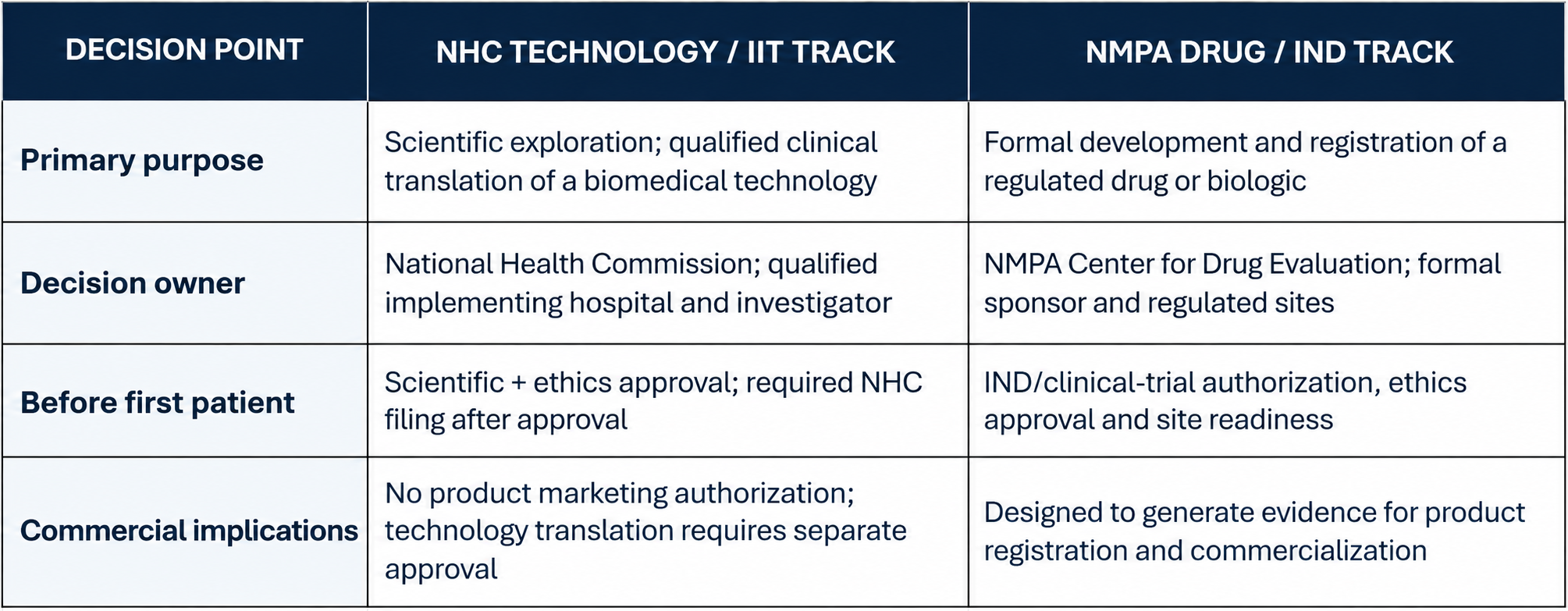
Source: State Council Order 818; NHC 2024 IIT framework; NHC classification guidance issued April 2026. [1–3]
Order 818: six requirements that affect the investment case
Qualified institution: covered studies must be implemented by a Grade III-A hospital with suitable academic and ethics committees, operational capability and sufficient funding; the lead investigator must be appropriately qualified. [1]
Domestic legal sponsor: an initiating institution must be a legal entity established in China. Overseas biotechs therefore need a legally appropriate domestic structure or qualified partner, rather than assuming a foreign parent can initiate directly. [1]
Review and filing: academic/scientific and ethics approval precede filing; the hospital must file with the NHC within five working days after those approvals. The same period applies to material amendments after approval. [1]
Participant protection: written informed consent is mandatory; neither the initiating institution nor study hospital may charge participants research-related costs. Research-related injury treatment obligations must be addressed. [1]
Safety and records: serious adverse reactions require suspension, ethics reassessment and reporting within five working days; source records are retained for 30 years after study completion, or permanently if offspring are involved. [1]
Quality escalation: WS/T 901–2026, the national clinical-research quality-system standard, was issued June 10 and becomes effective December 1, 2026. [4]
CRITICAL DISTINCTION The April 2026 classification guidance links technology-track study data to biomedical-technology clinical translation; drug development follows drug-authorization and registration rules. Potential FDA/EMA use of foreign data is a separate, case-specific question—not permission to ignore China's intended-use classification. [2, 8–9]
2 | Timelines, economics and hospital strategy
What the approval clocks actually mean
The statutory five-working-day NHC filing period begins only after scientific and ethics approval. It is a post-approval filing obligation—not a five-day approval, guaranteed first-patient date or exemption from technical review. A practical sequence is: pathway classification and nonclinical/CMC readiness; domestic partner and site selection; scientific and ethics review; contract and budget execution; applicable human-genetic-resource/data permissions; NHC filing; initiation and first patient. [1–3, 13]
For registration-oriented assets, eligible Class 1 innovative drugs may receive a 30-working-day NMPA review; eligibility and dossier completeness are conditions, not universal entitlements. US IND review generally runs on a 30-calendar-day statutory clock after a complete submission, but FDA identifies pre-IND preparation, institutional review, contracting and site activation as the larger real-world bottlenecks. Compare complete critical paths—not isolated regulatory clocks. [5, 7]
Cost advantage: substantial, but not a substitute for a budget
Published industry analysis reports Phase I costs in China approximately 32%–52% below US levels. A separate historical non-small-cell-lung-cancer Phase III benchmark estimates direct per-patient costs of roughly $25,000 in China versus $69,000 in the United States. Neither figure is an IIT quotation, a current rate card or a gene-therapy budget. [14, 18]
A defensible budget must include product/CMC release, import or local manufacturing, investigator and hospital costs, independent monitoring, pharmacovigilance, DSMB support, long-term follow-up, participant injury coverage, translation, source-data verification, HGR compliance, data transfer and FDA/EMA bridging. Savings disappear quickly if the study must be repeated.
A practical shortlist—not a substitute for site diligence
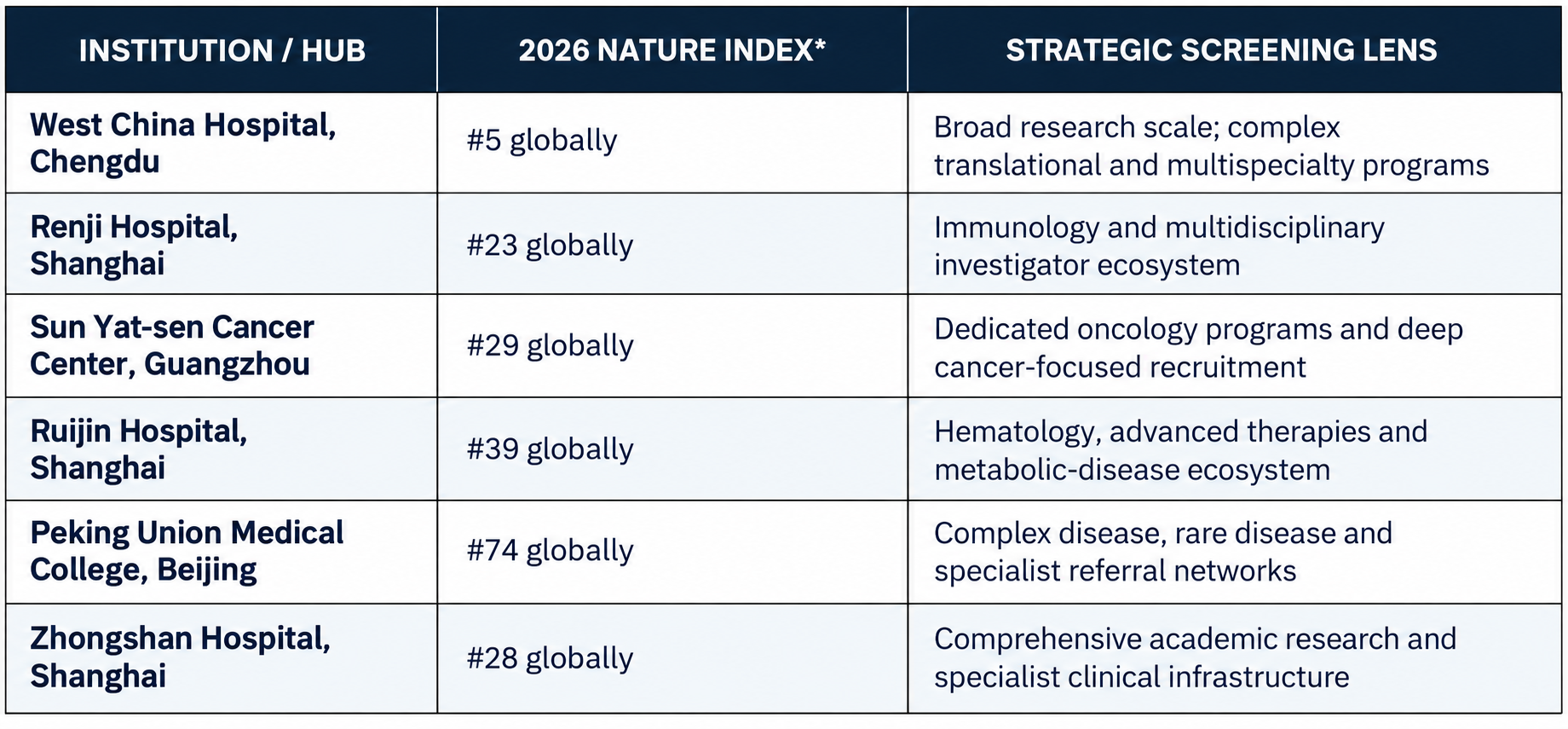
*Nature Index ranks publication output, not GCP performance, patient safety, trial quality, regulatory standing or suitability for any specific protocol. Confirm current Grade III-A eligibility, PI expertise, active workload and relevant study history independently. [6]
SITE-SELECTION TEST Demand modality-specific experience; independent safety capability; inspectable source records; robust dose-escalation controls; written escalation/reporting rules; appropriate ICU access; and clear rights to data, samples, publications and intellectual property.
3 | Case studies: upside and the 2026 safety reset
EsoBiotec: how an early human signal can reshape value
Belgian biotech EsoBiotec initiated a China investigator-led in-vivo CAR-T study in December 2024 and reported its first patient dosed in January 2025. On March 17, 2025, AstraZeneca announced an acquisition valued at up to $1 billion: $425 million upfront and up to $575 million tied to development and regulatory milestones. The timing illustrates how credible early clinical activity can inform partnering; it does not establish that a single IIT caused the transaction or eliminated registration risk. [15]
Three recently disclosed events CEOs must understand
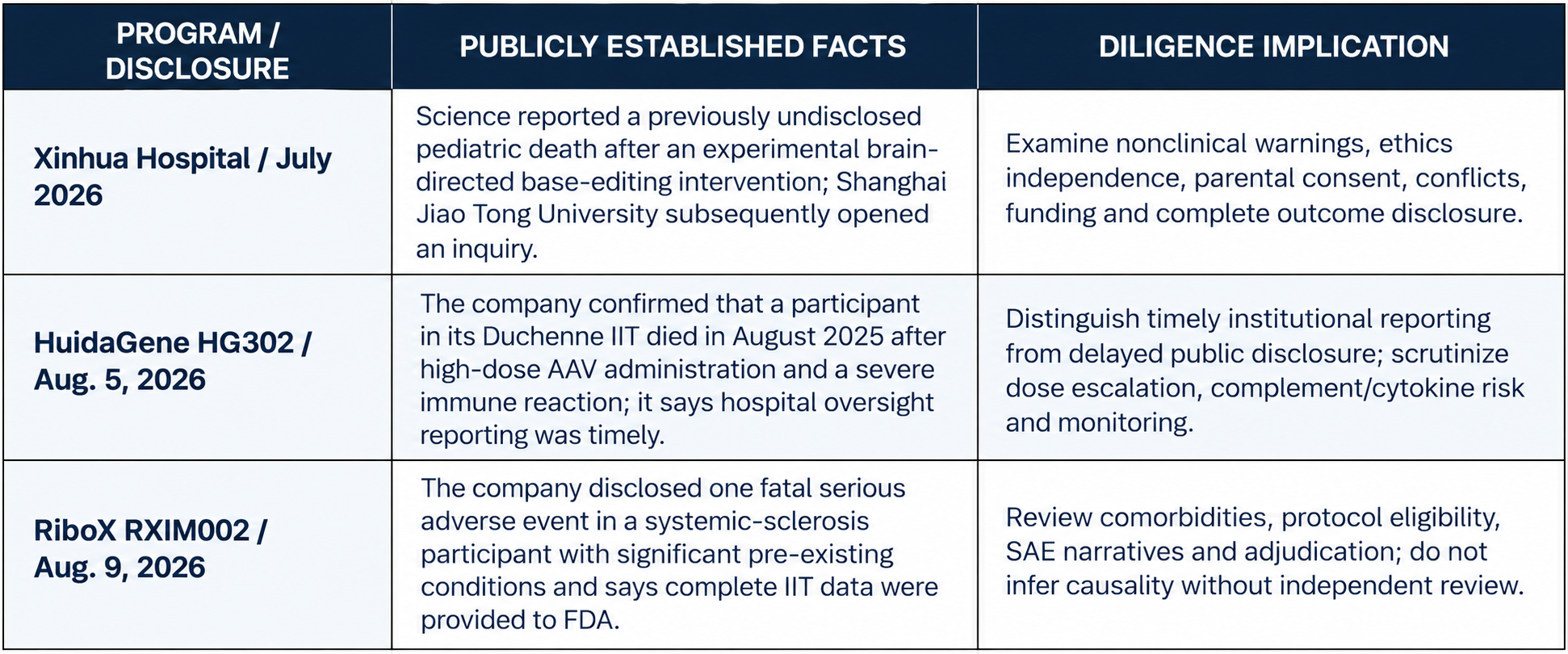
Sources: Science reporting and subsequent university inquiry; HuidaGene and RiboX official company statements. Events and disclosures occurred on different dates. Causality, legal responsibility and regulatory compliance must be determined case by case. [10–12]
From safety signal to cross-border transaction risk
Recent US media reporting describes lawmakers asking FDA to tighten acceptance of China-origin clinical data and increase site-audit requirements. These are reported legislative requests—not a blanket FDA prohibition or a newly enacted universal audit rule. Separately, FDA announced in June 2025 that new trials involving export of American participants' living cells to China or other identified countries for genetic engineering would face restrictions; that targeted action is not equivalent to a ban on all China-based IITs or all foreign clinical data. [16–17]
GOVERNANCE STANDARD Build an independent DSMB or proportionate external safety committee for higher-risk modalities; document stopping rules, SAE ownership, immediate cross-border escalation, complete disclosure, qualified assays, product comparability and inspection-ready source access before first dosing. [8–9]
4 | CEO decision framework and MSQ advisory support
An IIT can be strategically attractive when a genuinely exploratory clinical question, strong nonclinical support, a qualified Chinese institutional partner and a defensible evidence plan converge. It is less attractive when the intervention clearly belongs on a product-registration pathway, when ownership or cross-border data rights are unresolved, or when a site cannot meet the same patient-protection standards expected in the United States or Europe.
Asset evaluation first. Assess whether the program is well suited to a China IIT or industry-sponsored trial (IST), determine which pathway offers the greatest strategic, regulatory, timeline and cost advantages, and define how the resulting data will support the program’s global development objectives.
Validate the site and partner. Audit hospital/partner qualification, investigator track record, ethics independence, clinical operation capability and source-data accessibility.
Design for portability. Specify ICH E6(R3), 21 CFR 312.120, monitoring, consent, assay qualification, product comparability and FDA/EMA engagement. [8–9]
Monitor the perimeter. Resolve HGR approvals/filings where applicable; allocate IP, samples, publications and data rights; assess US/EU geopolitical and supply-chain exposure. [13, 16]
Execute the full critical path. Compare risk-adjusted time, complete study cost and downstream bridging requirements against a China IND, US IND or other jurisdiction.
HOW MSQ CAN SUPPORT MSQ advises US/EU biotech management teams, boards and investors on China IIT-versus-IND pathway strategy; hospital and PI diligence; safety, ethics and protocol governance; cross-border HGR/data/IP planning; FDA/EMA evidence strategy; and partnering, licensing and transaction diligence.
Selected sources
[1] State Council Order 818: full text; effective May 1, 2026
[2] NHC: biomedical technology versus drug/device classification guidance
[3] NHC: investigator-initiated clinical research management measures (2024)
[4] NHC: WS/T 901–2026 quality-system standard; effective December 1, 2026
[5] NMPA: optimized innovative-drug clinical-trial review announcement
[6] Nature Index: 2026 global healthcare-institution research rankings
[7] FDA: America Must Address Early Clinical Development, August 2026
[8] FDA: foreign non-IND clinical studies and 21 CFR 312.120
[9] EMA: ICH E6(R3) GCP; Annex 2 becomes effective January 15, 2027
[10] Science: undisclosed pediatric gene-editing death in China
[11] HuidaGene: official HG302 first-in-human safety update
[12] RiboX: official RXIM002 investigator-initiated trial safety update
[13] China MOST: human-genetic-resource international collaboration FAQ
[14] Pharmaceutical Executive: China trial economics and EsoBiotec timeline
[15] AstraZeneca: official EsoBiotec acquisition announcement and deal terms
[16] FDA: targeted restrictions involving export of US participants' living cells
[17] BioSpace: US lawmakers request tighter China-data policies after three deaths
[18] Clinical Trials Arena: H1 2026 Phase I China-versus-US cost comparison
This paper provides strategic information, not legal, medical or regulatory advice.