2026 Global Biopharma Leadership Forum
january 11, 2026
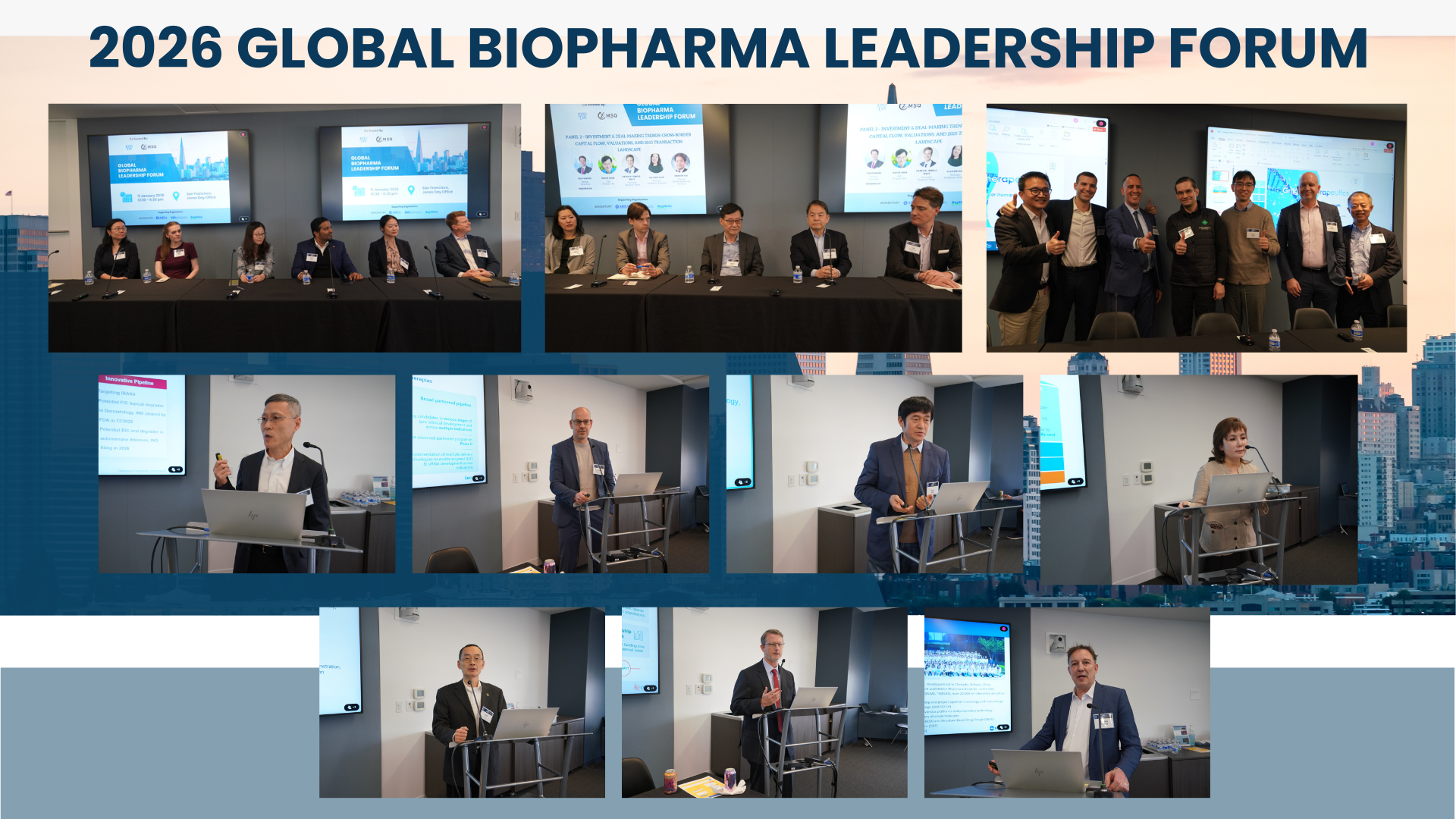
Continuing the momentum from our morning Executive Workshop, we hosted the 2026 Global Biopharma Leadership Forum at Jones Day in San Francisco. Co-hosted by MSQ Ventures and Jones Day, and supported by The BayHelix Group, American Healthcare Executive Association, BioCentury Inc., and KKH Advisors, the forum brought together senior leaders across the global biopharma ecosystem for an afternoon of forward-looking dialogue on capital markets, deal-making, and the accelerating role of artificial intelligence in drug development.
Across all panels, the discussions reflected a market that is reopening, but with sharper selectivity, alongside a technology wave that is moving from promise to operational reality.

Panel 1 – Global Strategy & MNC Outlook How leading pharma integrates regional innovation and partnership models
Moderated by Echo Hindle-Yang, Founder and CEO of MSQ Ventures, the opening panel convened global pharmaceutical and partnership leaders to examine how multinational companies are evolving their innovation sourcing models, governance structures, and cross-border execution strategies.
Panelists included – Ying Niu, China Search and Evaluation Lead, Pfizer, Jocelyn Yu, Partner, Jones Day, Mike Patten, Chief Strategy Officer, Harbour BioMed, Alexandria (Alex) Cogdill, MEng, PhD (Alex) Cogdill, Head of Strategic Initiatives, Global BD, Daiichi Sankyo US, Nikhil Mutyal Ph.D., Head of Search & Evaluation, Respiratory & Immunology, AstraZeneca, Dan Zheng, Head of Regional Innovation & Partnerships, Takeda
Where Global Strategy Is Truly Decided
The panel explored how global strategy is operationalized within multinational pharmaceutical organizations, particularly as innovation becomes more geographically diverse. Discussion centered on the balance between headquarters leadership, global therapeutic area teams, and regional business development groups. While portfolio prioritization, capital allocation, and late-stage development decisions often remain centralized, regional teams are playing a growing role in sourcing innovation, shaping early diligence perspectives, and informing market relevance. The conversation highlighted the need for strong internal alignment to ensure that global conviction is built on both scientific rigor and regional insight.
How External Innovation Is Really Filtered
Panelists examined how companies evaluate the growing volume of external innovation opportunities worldwide. The discussion addressed the early screening criteria that determine whether an asset advances into deeper diligence. Key filtering factors included scientific differentiation, clinical and translational validation, leadership credibility, and strategic fit within therapeutic priorities. The panel underscored that most opportunities are filtered out before reaching senior governance forums, reinforcing the importance for biotech companies to present clear data packages, compelling value propositions, and well-defined development strategies early in engagement.
What Breaks in Cross-Border Execution
Beyond sourcing and deal signing, the panel explored where cross-border partnerships most often encounter friction. Governance design, incentive alignment, intellectual property frameworks, data sharing protocols, and cultural operating differences were all cited as critical execution variables. The discussion emphasized that many partnership challenges emerge post-signing when operating expectations are not fully aligned at the outset. As collaborations span multiple regulatory systems and commercial markets, proactive planning around decision rights, communication pathways, and dispute resolution becomes increasingly important to long-term partnership success.
Closing Perspective
The session provided a strategic lens on how multinational pharma organizations are adapting to a more globally distributed innovation landscape. As sourcing becomes more international and partnership models more complex, effective global strategy depends on disciplined evaluation frameworks, empowered regional insight, and governance structures designed to support cross-border execution from day one.
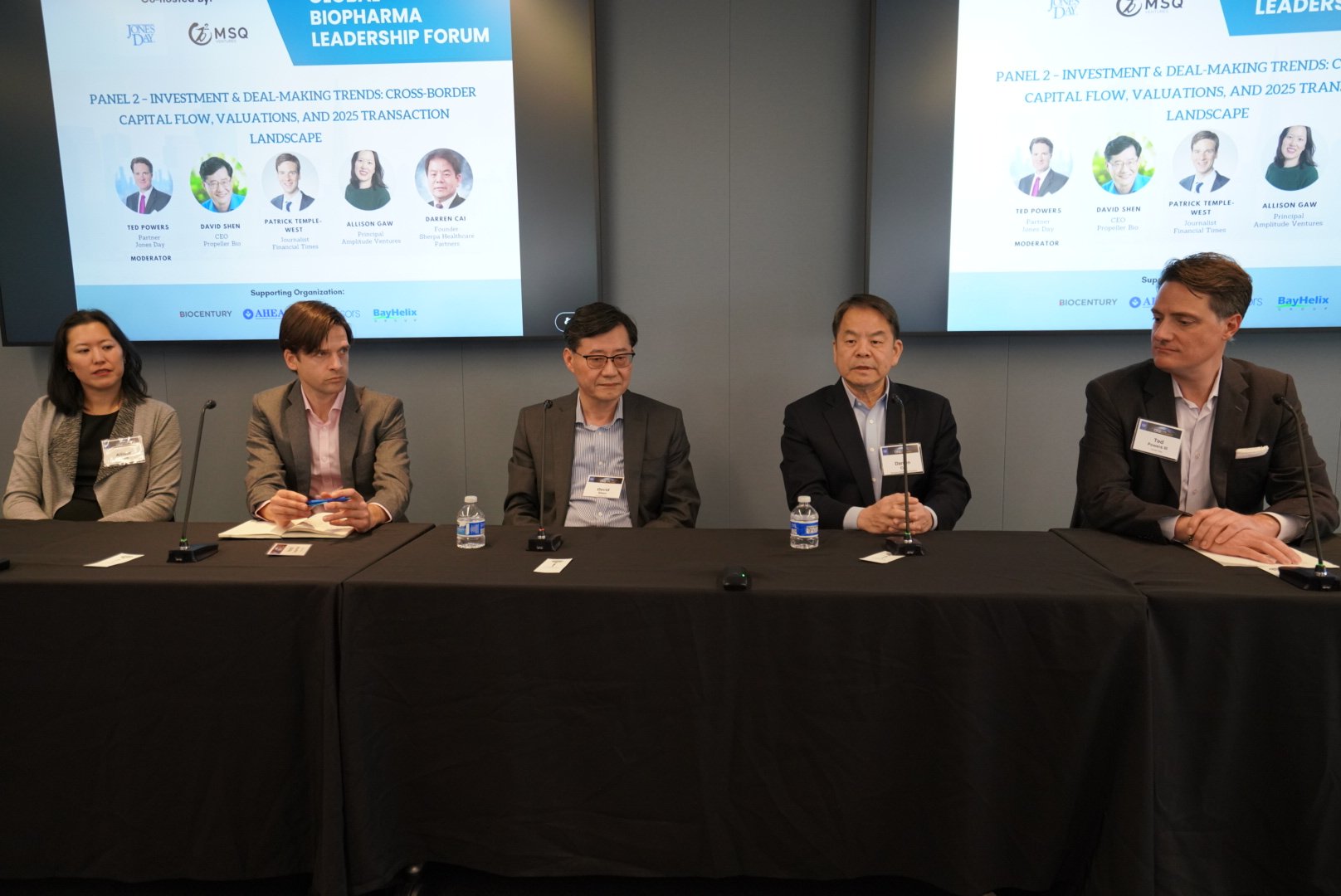
Panel 2: Investment & Deal-Making Trends: Cross-border capital flow, valuations, and the 2025 transaction landscape
Moderated by Ted Powers, Partner, Jones Day, the panel brought together perspectives from venture capital, company leadership, and financial media. Panelists included David W. Shen, CEO, Propeller Bio, Patrick Temple-West, Journalist, Financial Times, Allison Gaw, Principal, Amplitude Ventures, Darren Cairns, Founder, Sherpa Healthcare Partners (夏尔巴投资).
A Recovery in 2025, But Not a Broad Lift Across the Market
Speakers described 2025 as a stronger year than many expected, particularly in the second half, with improving momentum across financings and select transactions. At the same time, the panel emphasized an uneven recovery. High-quality companies with strong teams and differentiated assets were able to raise capital and attract strategic interest, while a large portion of the market continued to face a constrained fundraising environment and limited options.
Capital Concentration and the “Haves vs Have-Nots” Dynamic
Several panelists noted that capital remained concentrated in a narrower group of companies, with investors prioritizing leadership track record, clear differentiation, and programs that could be more readily de-risked. This created a widening gap where the top tier could raise sizable rounds, but many others struggled to secure funding, despite the perception that investors still had capital to deploy.
Cross-Border Deal Activity and the Hong Kong IPO Window
The discussion highlighted renewed cross-border activity, including deal momentum involving China-linked innovation and growing interest in Hong Kong as an IPO venue for many companies. Panelists suggested the U.S. market began showing signs of reopening in late 2025, and several expected a more balanced pull between U.S. and Hong Kong listings over time. A repeated caution was that market confidence depends heavily on post-IPO quality and performance, since one highly visible failure can dampen sentiment across the broader sector.
Deal Structure Preferences Are Shifting Under LP Pressure
On deal structure, the panel discussed how limited liquidity over recent years has made LPs more focused on near-term distributions, influencing preferences toward structures that return cash sooner. While licensing remains common, some panelists observed an increase in straight acquisitions and hybrid approaches, including acquisitions where management teams spin out earlier assets into a new company, creating a pathway for investors to redeploy capital while delivering a liquidity event.
Licensing vs Acquisition: Leverage, Risk, and Valuation Tradeoffs
Panelists described an ongoing push and pull between licensors and big pharma. Large pharma often favors licensing to reduce risk and preserve upside, while companies approaching IPO or seeking to protect valuation may resist licensing core assets, which can pressure strategics toward acquisition if they want full control. The conversation also touched on NewCo and equity-linked structures, noting that governance and control negotiations remain complex and that the frequency of equity-inclusive licensing has not always matched earlier expectations.
Regulatory Uncertainty Is a Major Variable for 2026
Looking ahead, panelists pointed to regulatory uncertainty, particularly around FDA leadership and predictability, as a major headwind. Several noted that policy shifts and volatility can materially affect timelines, investor confidence, and transaction appetite. The panel also discussed how geopolitics and supply chain considerations are influencing diligence and partnering decisions, including increased scrutiny of manufacturing footprint and CDMO exposure.
A Call for Diversification and Creative Cross-Border Positioning
In discussing how companies can reduce risk, panelists emphasized creative global structuring and diversified partnerships, including considering jurisdictions beyond the U.S. and China such as Canada, the UK, Europe, and Australia. The overarching view was that while optimism has improved, companies should plan for volatility and build flexibility into financing, regulatory, and partnering strategies.
Closing Takeaway: A More Active Market, With Higher Stakes on Execution
The panel closed on the idea that 2025 brought signs of reopening in capital markets and deal-making, but 2026 will likely reward disciplined execution and quality. Companies with clear differentiation, credible leadership, and flexible transaction planning were positioned to benefit most, while a broader set of companies may continue to face difficult funding conditions if public market windows narrow or regulatory uncertainty persists.
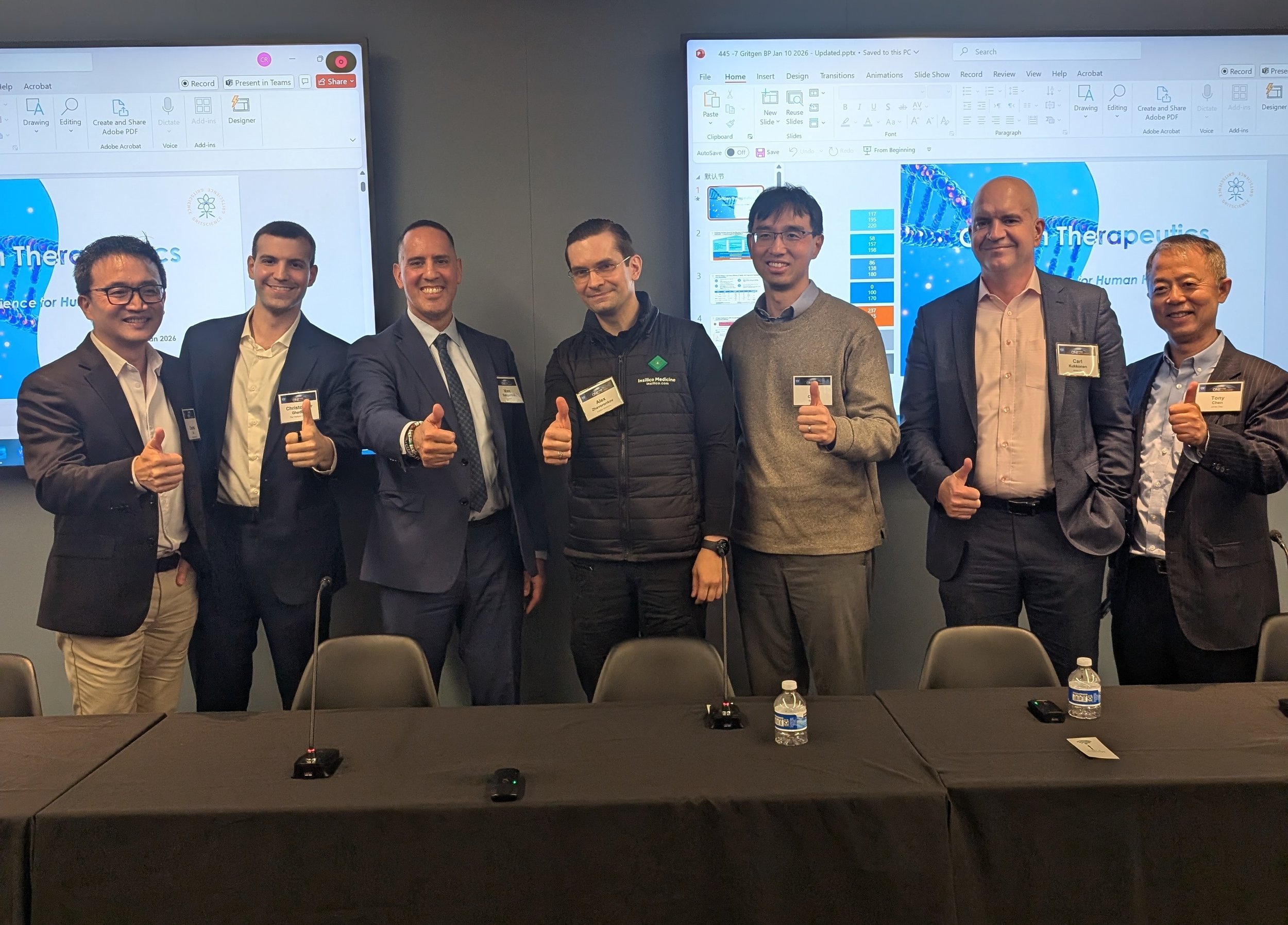
Panel 3: AI in Global Drug Development From target discovery to clinical execution — how AI is transforming speed and precision in biopharma
What Really Moves the Needle in Drug Development
Artificial intelligence has become one of the most overused words in biopharma. Almost every company claims to use it. Far fewer can point to where it truly changes outcomes.
At JPM 2026, MSQ, together with Jones Day, brought together industry leaders to move past the hype and have an honest conversation about what AI is actually doing in drug development today. The discussion was moderated by Marc Estigarribia, Managing Director and Senior Partner of MSQ Ventures, who guided the panel across discovery, development, investment, and governance perspectives grounded in real transactions and operating experience.
The panel featured:
Charles Lin, Principal, Illumina Ventures
Christopher Ghadban, Investor, The Venture Collective
Ethan Than, Global Digital/AI Strategic Partnerships & Transactions (BD&L), Sanofi
Alex Zhavoronkov, Founder, CEO and CBO, Insilico Medicine
Le Cong, Associate Professor, Baxter Faculty Scholar at Stanford University School of Medicine
Carl Kukkonen, Partner, Jones Day
Together, they explored one central question: where does AI genuinely create value, and where does it still fall short.
When AI Actually Changes Outcomes
Alex Zhavoronkov set the tone early with a simple but provocative idea. AI only matters when it measurably changes outcomes. In drug development, he argued, that impact is not spread evenly across the lifecycle.
The most meaningful and defensible value appears between the earliest concept and the nomination of a developmental candidate. This is where timelines can be compressed, probabilities can be improved, and learning can compound. If AI cannot consistently outperform traditional approaches in this window, it risks becoming a label rather than a capability.
This view sparked immediate engagement across the room and framed much of the discussion that followed. It also echoed a broader theme that surfaced repeatedly throughout the panel: real value comes from execution, not storytelling.
Moving Beyond Pilots Inside Big Pharma
From the perspective of a global pharmaceutical company, Ethan Than highlighted a different but closely related challenge. AI has already proven its usefulness in discovery, but the next frontier lies in clinical development.
Clinical operations are complex, slow, and expensive. They are also rich in data. When applied well, AI can reduce cycle times, lower the number of protocol amendments, and support better decisions across development teams. At that point, AI stops being an experiment and starts becoming part of how the organization works.
Ethan emphasized that this transformation does not happen automatically. It requires focus, validation, and discipline. Without a clear path from proof of concept to scale, even promising AI tools risk remaining stuck in pilot mode.
Why Data Alone Is Not Enough
Dr. Le Cong brought an academic and clinical lens to the discussion, shifting the focus from data availability to data integration. In many settings, the challenge is no longer a lack of data, but the ability to connect pathology, genomics, and clinical history in a way that supports real decisions.
He described how new AI systems can analyze complex multimodal data in minutes rather than months, and how this capability is beginning to extend beyond analysis into physical execution. Robotics and automation are increasingly translating AI insights into repeatable laboratory workflows.
The message was clear. Generating ideas is no longer the bottleneck. Testing them reliably in the real world is.
How Investors Tell Signal from Noise
From an investor’s standpoint, Christopher Ghadban addressed a question many founders face. How do you stand out in a crowded AI landscape?
His answer was direct. AI by itself is not a moat. What matters is whether the technology is solving a real biological problem and whether computational insight can be translated into assets that work in the physical world. Teams that successfully combine biology and computation are far more compelling than those that excel at only one.
This investor perspective reinforced a consistent message from the panel. AI platforms earn credibility not through claims, but through repeatable progress toward the clinic.
What AI Changes and What It Does Not
Charles Lin from Illumina Ventures addressed a common misconception that AI eliminates risk. In reality, AI reshapes how risk is evaluated rather than removing it.
Faster timelines and better early signals allow investors and operators to learn sooner and make more informed decisions. At the same time, the fundamentals of value creation remain unchanged. Market selection, indication strategy, and proprietary advantage still matter.
AI accelerates judgment, but it does not replace it.
The Overlooked Role of Governance and Due Diligence
From a legal and governance perspective, Carl Kukkonen, Partner, Jones Day and the panel converged on a practical view. AI is a tool, not an inventor. Ownership, data rights, and model use can be structured contractually, and intellectual property strategy remains relevant even as development cycles accelerate.
Where the discussion became most critical was around due diligence. Several panelists noted that AI is often underused in evaluating partners, platforms, and assets. Too many decisions still rely on presentations rather than structured, data driven analysis.
The implication was clear. If companies expect AI to guide discovery and development, they should also trust it to inform how partnerships and investments are evaluated.
MSQ’s Perspective
Across the discussion, one message became increasingly clear. AI does not create value simply because it exists. It creates value only when it is embedded into how decisions are made.
In drug development, the biggest breakthroughs do not come from models alone. They come from alignment between data, scientific judgment, operational execution, and capital allocation. AI amplifies this alignment when it is designed to support real decisions at each step of the lifecycle, from early discovery to portfolio strategy and partnership selection.
At MSQ, we see AI as an operating capability, not a feature. In our work with biopharma companies, investors, and AI native platforms, the most successful teams treat AI as a system that connects insight to action. They use it to prioritize programs, to stress test assumptions, to evaluate partners, and to decide where to deploy time and capital. When AI is isolated within a single function or treated as an experiment, its impact remains limited. When it is embedded across the organization, it becomes a source of sustained advantage.
This is also why execution matters more than narrative. The market has grown increasingly skeptical of AI stories that are not backed by measurable progress. What stands out instead are teams that can demonstrate learning velocity, repeatability, and disciplined decision making. These are the signals MSQ looks for when advising on strategy, transactions, and long-term growth.
Looking ahead, the winners in AI enabled biopharma will not be defined by who adopts AI first, but by who integrates it best. The companies that succeed will be those that turn AI into a repeatable engine for better clinical outcomes and stronger commercial decisions. That is where MSQ continues to focus its work.
The afternoon sessions illustrated an industry navigating dual transitions. Capital markets and deal activity are reopening, but with heightened scrutiny on quality, structure, and execution. In parallel, artificial intelligence is moving from experimental capability to embedded development infrastructure.
Success in this environment will depend on combining scientific innovation with financing strategy, operational discipline, and scalable technology integration. The leaders best positioned for the next cycle will be those who can execute across all four dimensions simultaneously.